Only money you can loseMost of these go to zeroExit plan before you buySeed phrase is the accountStart slow, start smallEvery DM is a scam
Beginner guide
Memecoin trading for beginners, without getting rugged.
The three apps we trade with, how to vet whoever is sharing a token, a plan for entry and exit, which chain to start on, and a first trade in four steps.
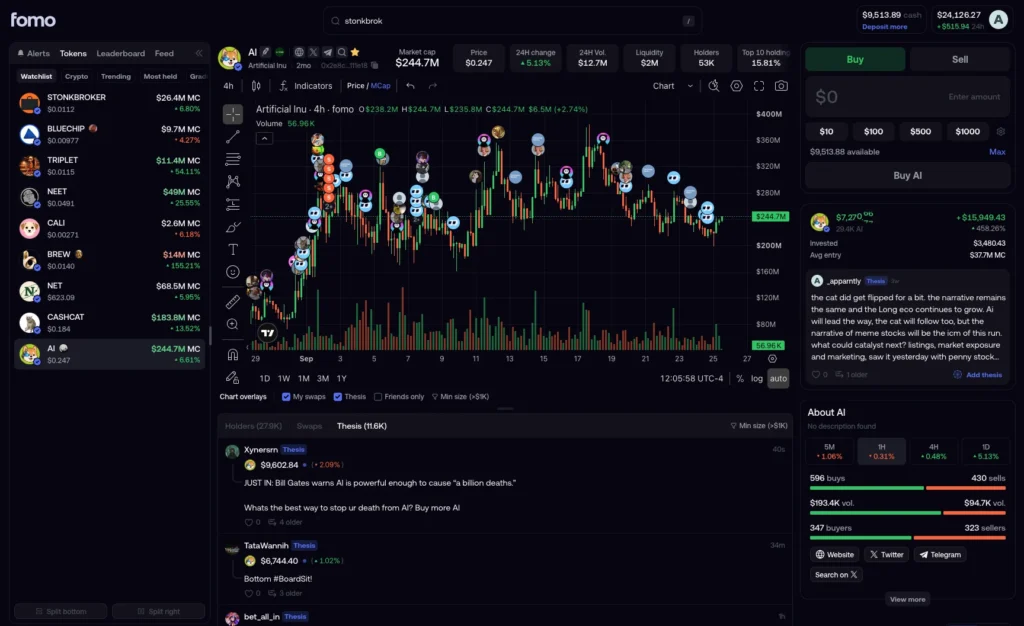
How to pick: start with fomo. It is our favourite for new users and the app this guide is written around. On Solana we also use Jupiter, a DEX aggregator, for plain swaps.
Knowing what to buy usually starts with someone sharing a token and an idea. Alpha is everywhere. Who is sharing it, why they are sharing it, and what you do with it matter more than the token.
If you cannot do due diligence on the token, do it on the sharer
A new token has no history. The account posting it does. You can read an account's last month of posts in ten minutes, and it will tell you more than the token's chart.
Who they are. Audience size matches engagement, not ten thousand followers and four replies.
What their goals are. Paid posts, pre-loaded bags, and calls timed after their own entry. Paid posts should be marked as paid.
How their last calls performed. Look at the last ten a week later, not the one they pinned.
Whether they post their wallet, and it is the one that trades.
When they post relative to their entry. A call that goes out after the buy is a request for exit liquidity.
1KOL posts the token on X
2you buy here, no plan
3you are still holding
4slow grind, months, never back to the top
Illustrative, not a real token.
Accounts we follow, and why
Jack Adams@JackAdams66No nonsense. Clear entries, the reasoning behind them, and how he reads a chart to find a token before the crowd does. All of it is documented on his profile, so you can check the record yourself. He also runs a paid private team: Jack Adams on Whop.
Sachs@gudmansachsEarly on several of the biggest runners we have watched. His posts read as his own view, not a paid slot. Not every call works out, which is the reason to size small and keep your own exit.
Kikcharts@kikchartsCharts every day, in volume. Follow for the method: how to read a chart and why a level matters. He is a trader, so his entries and exits are his; plan your own before you act on a token he posts.
DineroDom@DineroDom0Our first stop for new infrastructure and the founders behind it. We use his posts as a list of things to research, then decide on an entry ourselves.
Drift@0xtrendriftOne of the best chart readers we have followed, and we have followed him for years. He shares setups and chart analysis on live streams and is always scanning for the next opportunity. Watch to learn how a setup is built, then plan your own entry and exit.
JacalCrypto@JacalCryptoA recent follow, added the same way every account should be: read what they share, work out why, and see if it holds up. So far it has, mostly on technical analysis of charts.
Apparntly, our main account@_ApparntlyEverything we publish, every guide, every page.
Apparntly Memes, where we share some plays@ApparntlymemesMemes and trading. Same rules apply to us: check the timing, check the wallet, decide your own size and exit.
Whoever shared it, the token is their idea. The plan is the part you control, and section 3 is the plan.
3
How to trade it: a plan for entry and exit.
Sharer vetted or not, the trade is yours. Decide the entry, the exit and the size before the buy, then do what you wrote down.
Entry discipline
Plan the entry, then wait for it. Do not buy the vertical candle. If you missed it, you missed it.
Exit discipline
Sell in pieces. Take the initial out. Decide what kills the thesis before you buy, and sell when it happens.
Exit liquidity, one worked example
t+0A large wallet buys quietly at a low market cap.
t+2hThe call goes out. The chart is already up.
t+2h10You buy. This is the top of your chart.
t+3hThe large wallet sells into your buy and everyone else's.
t+1dYou are holding what they sold.
Reading a token page, the beginner version
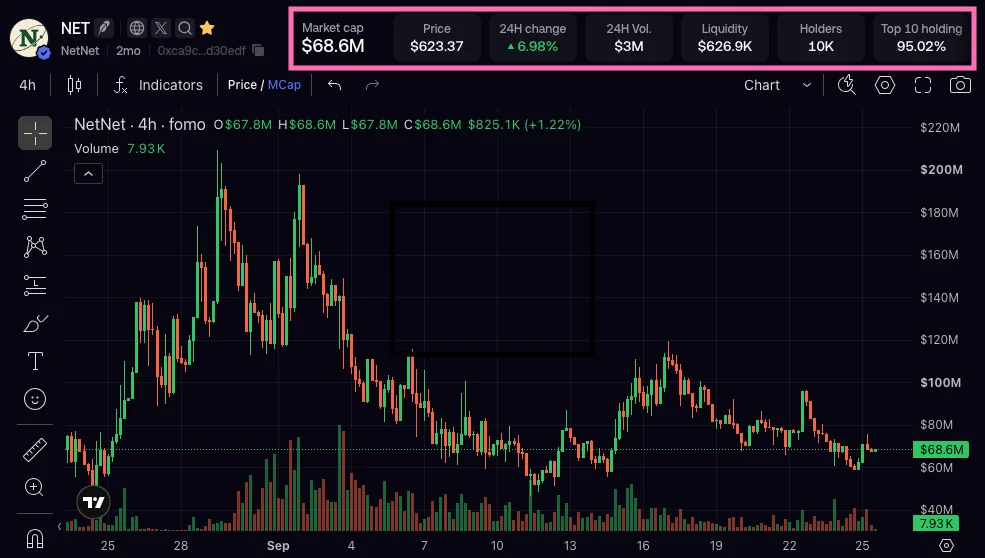
Market cap
Price times the tokens in circulation right now. The number most people mean when they say a coin is "big" or "small".
FDV, and the gap
Fully diluted value: price times every token that will ever exist. A big gap to market cap means much of the supply is not circulating yet. Why matters more than how much: unlocks land on known dates, staked supply sits still, and the project's page says which.
Liquidity
How much money sits in the pool you trade against. Thin liquidity means your own sell moves the price, and a big enough sell finds nobody to take the other side.
The advanced course, later
Holder concentration, bundle checks, dev wallets and wallet tracking, with GMGN, DEX Screener and the chain explorer as the tools for it. That is a later stage. For now: know how to buy, know how to sell, and have a plan.
Why Robinhood Chain right now, and why we still use Solana.
Robinhood Chain is the chain, not the brokerage. An Ethereum L2 where memes and tokenized stocks trade side by side.
live since July 2026new tokens launch on Pons, Long
Robinhood Chain went live on July 1, 2026, so its meme market is about three months old. Solana's is mature: deeper liquidity, and far more competition for attention. Solana is the established casino. Robinhood Chain is the new one, where everyone is still working out which tables are hot.
The chain was pitched for tokenized stocks. Memes took it over. Pons, its launchpad, plays the role Pump.fun plays on Solana. Long is where a new token gets paired with a tokenized stock. Pons does pairings too; Long does them well because of how its liquidity pools are built.
What we notice trading it: fewer launches on a normal day and fewer bad actors than Solana. They still exist, it is just not as nasty, so a wrong thesis can usually be exited with capital left. The other difference is the name on the door. Robinhood is a consumer brokerage with a wallet that feeds its own chain, and in meme markets attention is the scarce thing.
How to get on it
Sign up on fomo through our link, fund it with Apple Pay or USDC, and trade the chain from inside the app. No Robinhood account needed.
Who to watch on Robinhood Chain
The people building the chain and the things on it. Same rule as section 2: a post from any of them is a place to start reading, not a signal to buy.
Vlad Tenev, Robinhood co-founder and CEO@vladtenevWhere the chain is heading, from the person running the company behind it.
Ozzy, Pons developer@MEADGodPons is where new tokens launch on the chain. Follow for what is changing on the launchpad and why.
Nate, Long founder@Natan_benishThe person behind the stocks-and-memes idea on Robinhood Chain. Follow for where the pairings are heading. He is promoting his own product, so read it as that.
Long@longdotxyzPick a tokenized stock such as TSLA or NVDA, launch a new token on top of it, and trade it with the stock token setting the floor of the market. It is where memes meet stocks on this chain. Follow for new pairings.
Solana, honestly
Solana is where meme trading grew up. It is the original home of it, with the longest history, the biggest crowd and the deepest liquidity, and it is still a fantastic place to trade memes. New launches there need heavy research. We prefer Solana memes with at least a $1 million market cap, or established coins with some price history behind them, over brand-new launches. You can still go into the trenches and trade very low market cap memes if you want. Be careful: that is where your funds are most at risk unless you are fast, experienced, know how to research, and are following the right accounts and wallets.
fomo takes Apple Pay, a debit card, or a crypto transfer in. Apple Pay is probably the easiest: it buys a coin, which you can sell inside the app to have funds ready.
step 2 of 4
Build a thesis, then buy
fomo does not expose a slippage setting, so there is nothing to set. Read the thesis write-ups inside the app, look at many tokens before choosing one, write your own thesis in a sentence, then buy a small amount.
The money sitting in the pool you trade against. Thin liquidity means your own sell moves the price, and a big enough sell finds nobody on the other side.
Fear of missing out. The urge to buy because the chart is already up and everyone is posting about it. In memecoins it is the most expensive feeling there is, and it is usually how you end up buying the top. Not to be confused with fomo, the trading app.
The common shape of a memecoin chart: it explodes, then retraces 70 to 80% from the top before any leg back up. The retrace can happen within hours of the early euphoria, and the leg back up can take days. Buying the top on FOMO and holding through the retrace is how most beginners get hurt.
Information that is supposed to give you an edge: a token, a narrative, a wallet to watch. Everyone is sharing it. Who is sharing it and why matters more than the alpha itself. See section 2.
Someone bull-posting a coin they hold and believe in, working for their bags. Their conviction may be real. It is still a holder talking up what they own.
7
Questions people actually ask.
How much money do you need to start trading memecoins?
There is no minimum. We suggest a first budget of $25 to $50, enough to learn the app, the fees and the sell button while a total loss costs about a week of coffee. fomo's own guidance uses the same $25 to $50 starting range. Never fund it with rent money or borrowed money.
Is trading memecoins gambling?
It can be, if you treat it like one. Memecoins have no cash flows, prices move on attention, and insiders often sell first. We treat it as a real opportunity and accept that any position can go to zero, so we only trade money we are fine giving up.
Is the fomo app safe?
fomo is non-custodial: the wallet is created at signup, the key is split into shares through Privy, and the private key can be exported from Settings. Trades route through DFlow with MEV protection. The app is not the risk; the tokens are. There is a fee on every trade, so read the quote before you buy.
Is Pump.fun legit, and what does it charge?
Pump.fun is a real Solana launchpad, running since January 2024. Creating a coin carries a fee and so does every trade. The amounts change, so read the quote in the app before you confirm. We watch launches there before we buy anything.
Is Based Bot safe to use?
Based Bot works and publishes its 1% per-trade fee. It generates your wallet and lets you export the private key, so the funds are yours to move, but the bot also keeps a copy of the key and signs on your behalf. No legal entity, terms or country list is published. We fund it only with an amount we would accept losing, sent from a separate wallet.
How do you know if a memecoin is a rug pull?
You cannot know for certain. We review the team behind it, the number of holders and the wallets holding it, how much of the supply the top wallets hold, and whether the deployer has rugged before. A DM promoting the token is a warning sign on its own.
What is a KOL, and should you copy their trades?
A KOL (key opinion leader) is an account with an audience that shares tokens. Some are paid to promote a coin, in cash or in tokens. Others are traders sharing their own conviction, and sometimes it is both. We never blind-copy a call; we check the wallet, the timing and the disclosure first.
When should you sell a memecoin?
Decide before you buy. Our rule: sell enough at the first target to take the original stake out, sell the rest in pieces at levels written down in advance, and sell everything when volume falls while price holds or the thesis breaks. Raising the target instead of selling is how a winner becomes a round trip.
Why did my swap fail, and what slippage should you use?
A swap fails when the price moves past the slippage tolerance before the transaction lands, or when the network fee is too low to get it included. fomo handles this for you, so there is no slippage setting to change. On apps that expose one, a tolerance set too low fails and one set too high fills at a worse price.
Can you trade memecoins in the Robinhood app, and what is Robinhood Chain?
Robinhood's crypto app lists a short set of memecoins, including CASHCAT, PEPE, BONK and WIF. Robinhood Chain is separate: an Ethereum layer-2 on the Arbitrum stack, live since July 1, 2026, where thousands of memecoins trade on DEXs from a self-custody wallet. No Robinhood account is needed. You can trade Robinhood Chain memecoins on fomo.
Should a beginner start on Solana or Robinhood Chain?
We start on Robinhood Chain and graduate to Solana. Solana launched roughly 29,000 new coins a day in August against Robinhood Chain's 9,200, and its top 1% of wallets did 97.5% of volume, so it holds both the gems and the sharks. Robinhood Chain fees are congestion-priced and spiked in early September, so check gas before every trade. Figures as of September 28, 2026.
Do you pay tax on memecoin trades in the US and Canada?
Yes, in both. The IRS treats digital assets as property, so every sale, and every swap of one memecoin for another, is a taxable disposal; brokers report on Form 1099-DA from 2025 transactions. The CRA treats trades as dispositions producing a capital gain or business income. We are not tax advisers; read the IRS and CRA pages.
Nothing on this page is financial advice. It describes how we trade and what we use; what you do with your money is your decision. Some links on this page are referral links: sign up and you may get lower trading fees where applicable, and sometimes we get a bonus too.
Not sure where to begin?The apps, then a plan for entry and exit.